The Collaborator
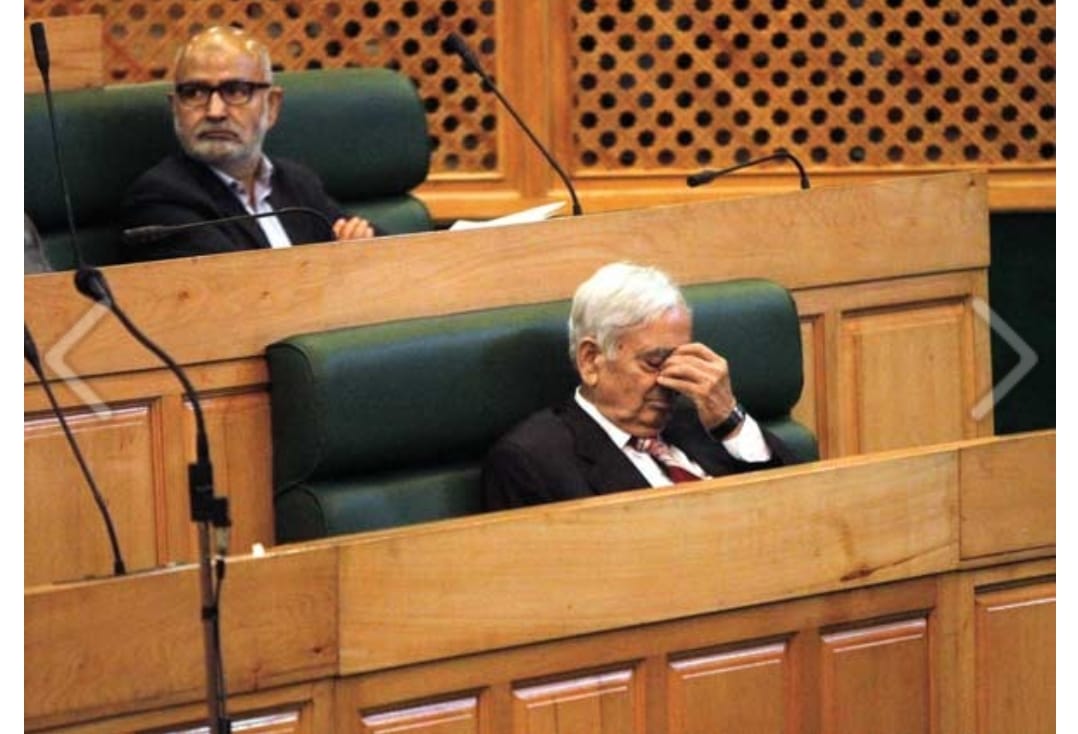
Towards the end of the session, Mufti Mohammad Sayeed, the chief minister of Jammu and Kashmir, and the leader of the assembly, rose to speak. Hawk-nosed and silver-haired, with heavy bags under his eyes and a slightly tense manner, Sayeed exuded the air of a disgruntled professor.
Sayeed began by paying warm tributes to the legislators, whom he had known, and outlived. He also paid tribute to the thousands of Hajj pilgrims who had been killed in a crowd disaster the previous month in Mecca, Saudi Arabia; two of them were from Jammu and Kashmir. Sayeed called for a “credible enquiry” into the incident, and demanded that people not play “a blame game on this tragedy.” He then began to recite a verse from the Quran.
Soon after he began, however, his memory failed him, and his voice petered out. He flailed his hands as he struggled to remember the verse. Instinctively, he turned to his right to look for help from a fellow member of the house. But there, instead of a colleague from his own party, the PDP, he found Nirmal Kumar Singh, the state’s deputy chief minister, a member of the BJP, the PDP’s coalition partner in the state. Sayeed stared expectantly, not seeming to realise that Singh, a Hindu, was unlikely to know any of the Quran’s verses. Singh stared grimly back at Sayeed. Smiles and muffled laughter spread through the assembly. Sayeed was saved by prompting from some of his own party members seated on the treasury benches behind him.
It was a minor impasse, but one unlikely to have occurred in the past. The Bharatiya Janata Party, or the BJP, became part of the state’s government for the first time in 2015, when it partnered with Sayeed’s Jammu and Kashmir Peoples Democratic Party, or PDP, after two months of negotiations. In the assembly elections held at the end of 2014, the PDP had emerged in the lead, with 28 seats, and the BJP followed, with 25 seats. Both were well short of the required 44-seat absolute majority mark.
The two parties’ decision to form a coalition, was surprising since they are, in many ways, fundamentally incompatible. And indeed, not only does the PDP draw its votes largely from the Muslims of Kashmir, while the BJP relies on the support of the Hindus of Jammu, the parties don’t see eye to eye even on the basic question of the relationship between Jammu and Kashmir and the union of India. Since its inception, in 1999, the PDP has promoted an approach of “soft separatism,” favouring talks with separatists, militants and Pakistan, and demanding a high degree of autonomy for the state. The BJP, on the other hand, does not recognise the space for such negotiation. It has long demanded the abrogation of Article 370 of the Indian constitution, which guarantees special rights to the state, including some degree of autonomy.
Apparently undeterred by the gulf between the two parties, Sayeed pushed forward with the coalition, travelling to Delhi at the end of February to meet Prime Minister Narendra Modi, exchanging an awkward hug with him in front of waiting cameras. Afterwards, he bravely assured journalists that this was “a historic opportunity with the government at the centre that has a clear mandate of people to deliver.” The results had shown that “the PDP is the choice of people in Kashmir and BJP in Jammu,” he said, and the parties had therefore decided to “unite together to give a government which will give all-round development to all the regions in the state.”
The bonhomie was short-lived. In early March, at the press conference held after the new government was sworn in, Sayeed expressed his gratitude to the separatist group Hurriyat, as well as “Pakistan and militant outfits for the conduct of assembly elections in the state.” It was a provocative statement, and was, predictably, met with outrage, as Twitter users took their cue from television hawks and declared that Sayeed was a “#ProPakCM.” Modi spoke out, and assured parliament, “If somebody makes such a statement, we can never support it.”
Since then, the two parties have expended significant time and energy locking horns with each other. They have fought over the release of the jailed separatist Masarat Alam Bhat, a proposed tax on helicopter rides to the Amarnath shrine, a court ruling reviving an archaic beef ban, and the location of a medical college. Many of these disagreements have had religious overtones, and some have spilled over into violence on the streets. Sayeed had claimed in the early days of the government that the alliance was an opportunity to bring Jammu and Kashmir together. But as one issue after another exacerbated tensions in the state, the government seemed rather to be driving the two regions and their people apart. Sayeed looked helpless throughout.
It is an uncharacteristic situation in which to find Sayeed. For most of his career he has had a close relationship with the government of India, working as the centre’s trusted man in Jammu and Kashmir, helping them exercise immense control over the state. He has also had his share of political rivalries, most notably with the Abdullah family, which has long dominated Kashmiri politics. But Sayeed’s style has always been one of backroom plotting, rather than open conflict. To see him besieged, as he is now, it is difficult not to wonder whether, after more than 50 years in which he has executed every kind of intricate political machination possible, Sayeed has made his biggest miscalculation yet.
A RETIRED GOVERNMENT EMPLOYEE I met in Sayeed’s hometown of Bijbehara, who has followed his career, gave me an unflattering description of him. Sayeed, this person said, “is what we Kashmiris call a choibaaz—a conspirator and a schemer.” Over the course of reporting this story, I interviewed nearly 100 people to try and piece together a picture of Sayeed’s personality and politics. I spoke to Sayeed’s former and present colleagues; politicians from across the spectrum, from mainstream to separatist; members of his family; his closest friends; bureaucrats, journalists and security officers who have known him; and former militants, among others.
Though the image of Sayeed that emerged was consistent with that given by the government employee, what also became apparent was that he did not develop into that kind of a politician in isolation. Rather, it was in the context of the Indian state’s crushing hold over democracy and politics in Jammu and Kashmir that Sayeed mastered the skills he needed to survive, and thrive. To understand Sayeed, then, is to understand how the government of India has, over decades, warped the very nature of democracy in Jammu and Kashmir, often distorting it beyond recognition.
Sayeed was born in 1936 in the town of Bijbehara, in the district of Anantnag, 40 kilometres south of Srinagar. He belonged to a family of Peers, an influential class of clergymen in charge of Sufi shrines and mosques, who are often described to outsiders as the “Muslim Brahmins of Kashmir.” He took an early interest in politics and was appointed president of his school federation, a kind of student union. “Once in our weekly meeting, when the teacher asked us about our ambition, I said ‘I want to be an English teacher,’” recounted Maqbool Ahmad Nadeem, a classmate of Sayeed’s from the time. “But Mufti said he wanted to be a leader.” Sayeed went on to study Arabic and law at Aligarh Muslim University, before returning to Anantnag and starting a practice in 1959 at the district court.
But his passions lay elsewhere. The 77-year-old lawyer Abdul Majeeb Khateeb, who knew Sayeed, and whom I met in the Anantnag court complex last September, told me Sayeed “was an average lawyer because, like the rest of us, he was too focussed on politics.”
In 1960, Sayeed obtained his first political appointment, as the district convenor of the Democratic National Conference, or DNC. This party comprised a group of left-leaning leaders who split from the National Conference to form an opposition party. But though purportedly a rival, by most accounts the DNC was in fact a creation of the centre, to enable it to occupy the opposition space. All its leaders went on to have close lifelong relationships with the central government for the rest of their careers.
Two years after it was formed, the DNC disintegrated under pressure from Nehru, according to Sampath Prakash Kundu, a trade union leader who was active at the time, and had links to the party. Many of its prominent leaders, including Sayeed, joined the NC. Jawaharlal Nehru had thrown the NC’s original leader, Sheikh Abdullah, into jail in 1953 for advocating freedom for Kashmir. (He would remain incarcerated for much of the next two decades.) Nehru appointed Bakshi Ghulam Mohammad as the head of the NC, and Jammu and Kashmir’s prime minister—the original title for the state’s highest elected office. This NC, which Sayeed joined, was effectively a shell for the Congress.
Given the Congress’s total control over elections in the state, when the party granted Sayeed his first assembly nomination, in 1962, as the NC’s candidate from Bijbehara, he was assured of a victory. Two years later, Nehru did away with the pretence of the NC functioning as a separate party. With the cooperation of the state’s then prime minister Ghulam Mohammad Sadiq, the NC was merged with the Congress.
In his spells outside prison, the Sheikh, who was known as “the lion of Kashmir,” kept up a furious attack against the Congress. He railed against the party’s top leaders in his public speeches, and called on the public to ostracise them. Sayeed was among those who faced his wrath. Ahmadullah Shah, a long-time resident of Bijbehara, remembered a public rally in the village at which the Sheikh said, dismissively, “I heard some malla kot”—son of a mullah—“has come up as a Congress leader here,” referring to Sayeed, who was an MLA at the time. Sayeed also became the target of a popular slogan, “Muftian kabar Kasheer-e-nebar”—Mufti’s grave outside of Kashmir, suggesting that he did not deserve the dignity of being buried in his homeland.
Still, Sayeed’s fortunes within the Congress rose steadily, even as Indira Gandhi assumed charge of the party after Nehru’s death in 1964. He maintained strong ties with key leaders, such as Makhan Lal Fotedar, a politician from south Kashmir known to be close to Indira. In 1967, Sadiq, as chief minister—as the post was now called—appointed Sayeed, his old DNC colleague, to serve as the deputy minister for agriculture and cooperatives.
But his ties with Sadiq did not dissuade Sayeed from participating in a plot to topple him. It would be the first of several such conspiracies Sayeed signed on for over the years, targeting different leaders. The coup was led by Sadiq’s rival Syed Mir Qasim, who headed the party’s state unit. Ghulam Nabi Mir Lasjan, a veteran Congress leader who was close to Sayeed, told me that it was Sayeed who “hatched the plan.” He recounted that a group of 32 MLAs loyal to Qasim “went to meet the high command to seek permission to go for a no-confidence motion” against Sadiq. “Mufti was the first to resign as deputy minister,” Lasjan said. Indira, however, scotched the plan, Lasjan said, telling them to “reconcile” and keeping Qasim happy by appointing him the minister for public works.
Combating the Sheikh’s influence was the Congress’s single most important goal in Jammu and Kashmir. To this end, Sayeed, who was given a state cabinet position in 1972, evolved a strategy of cultivating potential rivals to the Sheikh. Kundu, the trade union leader, told me that Sayeed allowed trade movements to grow “despite the fact that we were getting adventurous in a sensitive state.” According to him, Sayeed had a clear aim in mind. He “guided Mir Qasim not to crush our trade union movement because we could take on Sheikh later.”
Given the Sheikh’s massive popularity, Indira probably knew that any realistic long-term plan for the state’s politics had to include him. His long incarceration was probably a way to soften him, and make him more amenable to cooperating with the Congress. Fotedar, the leader who was close to Indira, told me that he had been “working on the Sheikh” through the Sheikh’s lieutenant Mirza Mohammad Afzal Beg, to convince him to cooperate politically with the Congress. Fotedar said, “Beg told me, ‘Mahaul banao’”—create a conducive environment—“‘we will come.’”
The result of these efforts was the 1975 Indira-Sheikh accord, after which the leader was freed from internment in Delhi and returned to the state as chief minister—but he was installed at the head of a Congress government. Many separatists saw the Sheikh’s move as a betrayal. “Sher ko geedad bana diya”—the lion was turned into a jackal, Ashraf Sehrai, a senior separatist leader who was active at the time, told me.
Congress leaders told me that the Sheikh suggested to Indira that he also be given charge of the Congress in the state, but that she refused. Instead, she gave Sayeed that responsibility, appointing him president of the party’s state unit, and the leader of the party’s legislators. In some ways, this was a counter-intuitive political move for Sayeed. Executive power lay not in party posts, but in ministries, which the Congress filled up with loyalists. “His juniors also became ministers, but he refused,” Mohammad Yousuf Taing, a scholar who worked with the Sheikh on his autobiography, told me. According to Taing, Sayeed told Indira that if he worked under the Sheikh, he would lose his own political identity and strength.
The Congress’s compromise with the Sheikh didn’t last long. The lawyer Khateeb, who was a young Congress leader at the time, recounted that the Sheikh took decisions without consulting the Congress. Worse, he “used to abuse the Congress though he became CM on our shoulders,” Khateeb said. “We youngsters revolted against the central Congress.” For some time, Indira ignored disgruntled local leaders who wanted the Sheikh sacked. But her own discomfort increased as the Sheikh’s clout grew.
In 1977, the foundations of Indian politics shifted after the Congress lost a national election for the first time ever, to the newly scrabbled-together alliance led by the Janata Party, which won 271 seats and formed the government. Realising that she was vulnerable and insecure, superseded Congress leaders in the state saw an opportunity to convince Indira to try and wrest power away from the Sheikh.
Sayeed was a key player in this plot. “Local Congressmen began hawking the idea that the resurrection of the party in the north could begin from its base in Kashmir where the party had a majority in the assembly already,” the journalist and author MJ Akbar wrote in his book Kashmir: Behind the Vale. “It could withdraw support from Abdullah, form a government of its own, and relaunch Mrs Gandhi by getting her elected from a Lok Sabha seat in the state.” Indira, Akbar wrote, was “uncharacteristically uncertain” and “depressed by defeat,” and did not stop what he described as “the Phoenix plan put into operation by the Congress chief in the state, Mufti Mohammad Sayeed.”
On 16 March 1977, the Congress MLAs withdrew support from the Sheikh, and Sayeed asked the governor, LK Jha, to permit him, as the state leader of the majority party, to take over as chief minister and form the government. But the canny Sheikh executed a counter-manoeuvre and asked the governor to dissolve the house and call for fresh elections. Reviving the NC ahead of the polls, he prepared to battle the centre.
The 1977 elections, conducted under the Janata government, were widely believed to be the first fair elections to be held in the state. “For the first time, there was no mass rejection of nominations, no disappearance of nomination papers, no forced withdrawal of candidatures and no eve of the poll ban on political parties,” reported India Today. The Sheikh had last led the state in 1952; there had been three successive Congress governments after him. Still, the Sheikh won seats in all the three regions of the state, a feat that has not been repeated since, by any party. The NC won 39 out of 42 seats in Kashmir, seven out of 32 seats in Jammu and one out of two seats in Ladakh. The Congress drew a blank in the valley, won ten seats in Jammu and one seat in Ladakh. Sayeed lost from his hometown, Bijbehara. It was a humiliating defeat for the Congress, for Indira, and for Sayeed.
THE 1977 ELECTIONS MADE CLEAR HOW FEEBLE the Congress’s party structure in the state was and how popular the Sheikh’s NC, which had a strong cadre base. After the debacle, Sayeed rolled up his sleeves and got to work to build the Congress’s base in the state from the grassroots.
I interviewed several Congress members from Kashmir, all of whom spoke highly of Sayeed’s work during this period. “Congress party in Kashmir has been built up by him,” said Ghulam Nabi Monga, currently the vice president of the Congress in Jammu and Kashmir, who joined the party in 1975 and worked with Sayeed. “He wouldn’t let anybody rest. The credit goes to him for what you see today.”
In the last week of August, I visited the crumbling two-storey Congress office building in central Srinagar, and met veteran party workers who remembered Sayeed with affection, describing him as “jurratmand,” or brave, and “worker-parast,” or pro-worker. Up a creaky staircase was a room whose walls were lined with photographs of past presidents of the party’s state unit. A sullen Sayeed was among them.
“Nobody had the guts to fight the Sheikh,” Nazir Bhat, a senior Congress worker, told me. “After 1977, we neither had power nor government but Mufti fought alone and became the unopposed leader.” Many Congress members I met told me that Sayeed would go from village to village trying to find people who would join the party. “He knows every house in every village of south Kashmir,” Abdul Razaq Wagay, the former MLA of Shopian, told me.
“Sheikh saab was like the big tree around which nothing else grows or attempted to grow,” Vijay Dhar told me. “Anybody just keeping the base was a great achievement.” With Indira providing backing from the centre, as the president of the state party unit, Sayeed ran a kind of parallel administration in the state. “For instance, under Hajj quota of the central government, if the state got a sanction for 4,000 people, then Mufti would get 500 separately,” Sheikh Ghulam Qadir Perdesi, the district commissioner of Srinagar at that time, told me. “If the government has to give some permits, 25 percent would be given to Mufti. If Sheikh gave freedom-fighter pension to the NC members who fought in 1947, Mufti, though nobody fought for Congress here, would get some pensions granted for Congress workers.”
Sayeed also attacked the Sheikh directly. He organised strikes regularly, and brought out what the Congress called a “red book” containing charges of corruption against him. “He brought him down from the tower of unreasonable height,” Kundu told me, “If not for Mufti he would have been a demigod.”
In September 1982, after the Sheikh died of a heart attack, leadership of the NC passed onto his son Farooq, who was the state’s health minister at the time. With the approval of Indira, who was now back in power at the centre, Farooq was sworn in as the chief minister of Jammu and Kashmir. For the next several years, he would be Sayeed’s political nemesis.
Indira probably hoped that the son would be a more amenable politician than his father. They shared a fond relationship, and Farooq addressed her affectionately as “mummy.” But she soon realised that when it came to politics, he was just as combative as his father. Ahead of the state elections in 1983, when she extended an offer of alliance to Farooq, he refused.
Furious, Indira unleashed the full might of the centre against him, campaigning for six days in the valley using an army helicopter, accompanied only by Sayeed, in whom it was clear she placed considerable faith. “Today, next to Mrs Gandhi, it is Mufti who is being touted … as the vote-grabber,” the India Today journalist Inderjit Badhwar wrote. “Quarter-page advertisements, being inserted every day now in all important dailies of the state … include only a photograph of Mufti.”
But at the end of this bitter battle, it was the NC that emerged victorious, with a total tally of 46 out of 76 seats, giving Farooq a majority in the assembly. Sayeed had contested two seats—Bijbehara again, as well as Homshalibugh—perhaps in the hope of winning at least one, after his embarrassing loss in 1977. He lost both.
Indira soon began to plot her revenge against Farooq. Over the next year, she targeted him with allegations that he supported the Sikh militants of Punjab. Sayeed accused him of having links with the militant group the Jammu Kashmir Liberation Front, or JKLF. In his memoir, My Dismissal, Farooq recounted that the efforts to brand him a secessionist were “a ruse to inflame the minds of the majority community in the rest of country to justify action against me and secure public support for it.”
In the summer of 1984, Sayeed found himself once again at the centre of a plan to pull down an elected government, this time orchestrated by Indira. In his memoir, Farooq said that the plan was codenamed Operation New Star. “The plan to overthrow my government, was given final shape … in Delhi when Mufti Sayed [sic] was summoned there,” Farooq said in his account. The strategy entailed bribing MLAs to defect from the NC, and then asking the governor to dismiss Farooq. When the governor BK Nehru refused to be party to the scheme, Indira replaced him with the more pliable Jagmohan. The new governor dutifully summoned Farooq and told him that 13 of his MLAs had defected, and that he was dismissed.
“The new government was formed by spending a lot of money,” wrote AS Dulat, the former chief of the Research and Analysis Wing, in his memoir, Kashmir: The Vajpayee Years. Dulat, who, from the late 1980s, worked in several high-ranking government offices in the state, had a ringside view of its highest political circles. According to him, “The money went in an IB [Intelligence Bureau] bag, and was distributed by a big businessman who used to be a Congress MP.” It was difficult to doubt that the defectors had been bribed when, after taking power, the new chief minister, Ghulam Mohammad Shah, made all 13 MLAs cabinet ministers.
In 1985, Sayeed managed to enter the state assembly after winning a by-election in Ranbir Singh Pura in Jammu. But his greatest ambition continued to gnaw at him. BK Nehru, the former governor of the state, in his memoir, Nice Guys Finish Second, wrote, “The fact that the National Conference had won 38 seats in the valley and the Congress had won only two did not deter Mufti Sayeed from dreaming dreams of becoming chief minister of Jammu and Kashmir.”
This relentless drive may have led Sayeed to resort to a sinister strategy. In 1986, after the locks of the Babri Masjid in Ayodhya were opened, riots broke out in some parts of the country. While Kashmir was largely undisturbed, violence did break out in one district: Anantnag, Sayeed’s stronghold. Here, a number of temples were desecrated, and houses of Pandits were attacked.
During my reporting, I heard allegations that Sayeed himself had organised this violence. Yusuf Jameel, a senior Kashmiri journalist, who covered the riots, told me he heard that “Congress was behind it because they had problems with GM Shah and wanted to get rid of him.”
“An atmosphere of insecurity was created against Kashmiri Pandits,” I was told by Ghulam Hassan Mir, one of GM Shah’s defectors in 1984, who later co-founded the PDP. “Mufti saab was behind it,” he added. Pandit community leaders I met in Jammu concurred on the question of Sayeed’s involvement. “Mufti engineered the riots,” Ajay Kumar Chrungoo, chairman of Panun Kashmir, an organisation of exiled Kashmiri Pandits, told me. He claimed that the Congress “constituted a committee that indicted Mufti, but the report was never made public.” Monga, the current vice president of the Congress in the state, said, “Mufti wanted to be the CM,” and that he “had an understanding with Gul Shah’s MLAs,” who agreed to support him. “He was building pressure,” Monga claimed. “Had the central leadership agreed, he would’ve been the CM.”
But Rajiv Gandhi, who had taken over the Congress after his mother’s assassination in 1984, had a different plan. Appointing Sayeed chief minister would have meant slighting Farooq Abdullah, with whom Rajiv was friends. On 7 March 1986, Rajiv had Shah sacked and imposed governor’s rule on the state. Instead of appointing Sayeed chief minister, Rajiv shifted him out to Delhi, giving him a seat in the Rajya Sabha and the post of union tourism minister. Moving Sayeed out was a step towards bringing Farooq back to rule the state. Abdul Gaffar Sofi, a long-time associate of Sayeed from Anantnag, and a co-founder of the PDP, told me, “Rajiv and Farooq’s friendship came in between Mufti saab and his ambition.”
IN NOVEMBER 1986, RAJIV AND FAROOQ signed an accord that reinstated Farooq as chief minister, and proposed a roadmap for stabilising the state, with the centre’s cooperation. When Farooq was asked why he needed the Congress’s support at all, when he had won a comfortable majority in the state, he replied, “The Congress commands the centre. In a state like Kashmir, if I want to implement programmes to fight poverty and disease and run a government, I have to stay on the right side of the centre. That is a hard political reality that I have come to accept.”
Many senior Congress members in the state, including Sayeed and Arun Nehru, were opposed to the accord, no doubt fearing that Farooq’s return would diminish their influence. “Mufti opposed the accord tooth and nail,” Sofi told me. “He said, ‘People upset with the NC would go to Congress and vice versa, now where will they go if they join hands?’”
Farooq probably also had revenge on his mind when he took up Rajiv’s offer. Badhwar wrote in India Today that one of the reasons for his “quick embrace of the centre” was probably to “ensure the quick political demise” of the NC MLAs who had defected in 1984, as well as Sayeed, “whom Farooq blamed for engineering the defections that toppled his government.”
The new chief minister sent a clear signal of antipathy towards Sayeed by appointing to his cabinet Mir Lasjan Mir, a long-time political rival of Sayeed’s. Lasjan Mir had only recently written “a lengthy confidential memorandum to the prime minister outlining corruption charges against Mufti,” Badhwar wrote. Farooq underlined his message by giving Lasjan Mir charge of the ministries of civil supplies and transport, “which have traditionally been the strongholds of patronage dispensed by Mufti’s group,” Badhwar wrote. An embittered Sayeed walked out midway through the swearing-in ceremony of the new government.
Though he was unhappy with the party, as the senior-most Congress leader in the state, Sayeed probably could not avoid campaigning responsibilities ahead of the 1987 elections. But a high-ranking government security officer who was present at one rally that Sayeed addressed, in the town of Khanabal in Anantnag district, told me how, at that rally, Sayeed promoted a new coalition, the Muslim United Front, whose symbol was a pen and inkpot, even while pretending to campaign for the Congress. Also present was Najma Heptullah, then a Congress leader, who was overseeing the party’s campaign in the state. According to the officer, Sayeed told the audience, “No need to tell you who to vote for, my Congress people, there is a tradition.” But even as he said this, the officer added, “he took out the pen from his pocket, holding it and repeatedly shifting it from one hand to the other.” As he did this, he used his “free hand to touch an imaginary flowing beard.” The gestures, the officer said, were a clear “reference to the pen and inkpot, and the beard of the MUF candidates.” According to the officer, Heptullah, who is from Madhya Pradesh and does not speak Kashmiri, “had no clue” what Sayeed said.
The MUF was the closest group the state had ever seen to a spontaneous local political formation. The Congress, NC, and even the Janata parties, were all parties from the centre, or with strong links to the centre. The MUF was the first local challenge to this order.
After weeks of campaigning, votes were cast on 23 March 1987. The next day, counting began. As the numbers were tallied from districts across the state, it started to become clear that the MUF had received an encouraging response from voters. To date, there is no precise information available about exactly how well the MUF performed in the elections. Most estimates put their final tally at a maximum of 15 or 20 seats, a potentially impressive debut for a fledgling political formation. But before the results could be known, the government, threatened by the prospect of a new political force, snatched the election away from the people.
“As the results came in, the victorious new government was busy arresting top MUF leaders … on charges of anti-national activities,” wrote Badhwar, who witnessed the rigging firsthand. “Chunks of the valley … were under virtual curfew even as votes were being tabulated at some counting stations five days after they had been cast.” The political scientist Sumantra Bose wrote, in the book Kashmir: Roots of Conflict, Paths to Peace, about a key contest featuring the MUF’s Muhammad Yusuf Shah. His opponent, Bose wrote, “routed in the contest, leaves the counting center in a visibly dejected mood and goes home. But he is summoned back—to be declared the winner by presiding officials.”
Taj Mohiuddin, a senior Congress leader, who was initially part of the MUF, told me, “The elections weren’t rigged by the NC but by the government of India.” Even Farooq, though he initially denied allegations of rigging, came to accept that it happened—even if he deflected the blame away from himself. In 1993, while the state was in the grip of militancy, Harinder Baweja of India Today asked him, “Didn’t the problem start largely because you rigged the elections?” “I am not saying the elections weren’t rigged,” Farooq said. “But I didn’t rig them.”
The crushing of popular will in 1987 is considered a turning point in the history of Jammu and Kashmir. It is widely agreed that the repression played a part in setting off the waves of militancy that flooded the state in the years that followed. Many of those who joined the militancy were MUF supporters who saw armed revolt as the only way forward against repression. Muhammad Yusuf Shah would take on the name Sayeed Salahuddin, and rise to head the Hizbul Mujahideen. His election manager from 1987, Yasin Malik, would go on to head the JKLF.
TOWARDS THE END OF THE 1980’s, SAYEED, DISGRUNTLED with his position in the Congress, sought an opportunity to reinvent himself politically. He seized an opportunity after communal riots broke out in Meerut in May 1987. Resigning from his post as union tourism minister, he deplored Rajiv’s “insensitive” approach to the violence, and returned to Jammu and Kashmir.
In an interview with Badhwar later that year, he criticised Rajiv’s leadership of the party. The Meerut riots had left him feeling that there was a “communal divide” in the country, he said. But he found that Rajiv was “incapable of reacting emotionally.” He ranted against the Rajiv-Farooq accord, and the sidelining of the old Congress guard. “No one consulted me” on the accord, Sayeed said. The prime minister, he insisted, had failed loyal party workers. Rajiv “is not like his mother,” Sayeed said. “She consulted us on every issue as she did a cross section of people. But now, after our sacrifices, we’re thrown away like flies, reduced to the status of pygmies.”
In the same interview, Badhwar asked him if he would start a new party. Sayeed replied, “The ball is in the leadership’s court. I’ve simply come back to square one.” While he would continue to address national-level issues, he said, “I will welcome VP Singh or for that matter, even leaders of the opposition, if they wish to address issues in this state.”
The nod to Singh wasn’t incidental. In July that year, Singh had been expelled from his post as defence minister in Rajiv’s cabinet for speaking out against the Bofors gun scandal. He seemed well positioned to emerge as the leader of an anti-Rajiv brigade. Sayeed’s strong stand against Rajiv paid off when Singh’s Jan Morcha movement transformed, in October 1988, into a political party, the Janata Dal. Singh appointed Sayeed to the new party’s steering committee.
In the next general elections, in 1989, Sayeed contested from Muzaffarnagar in Uttar Pradesh. He had never won a fair election in his life. Riding the wave of popularity for Singh in Uttar Pradesh probably seemed a safer bet than trying his luck again with the voters of Kashmir. Indeed, the Janata Dal won a huge majority of the seats in the state. Sayeed was one of the 54 successful candidates, out of a total of 85 seats.
In December, the National Front government came to power in the centre—a coalition of national and regional parties led by the Janata Dal, with the Left and the BJP providing outside support. Singh was sworn in as the prime minister, and chose Sayeed to be his home minister, usually considered the second-highest post in government. Sayeed was the first Muslim to ever head the ministry. According to Mohan Guruswamy, who was Singh’s close associate and informal advisor, Sayeed’s appointment was Singh’s way of showing that his was a secular government. “VP Singh wanted to send a signal that he is not concerned about the BJP giving support from outside,” Guruswamy said. Sayeed, too, spoke in support of this political vision. “To fight communalism and extremism is my first motto,” he said in an interview to India Today after he was sworn in. “While we believe that there is no problem which can’t be solved through negotiations, we will never compromise with those who divide the country.”
The challenge before Sayeed was enormous, largely owing to the strife in his own home state. Jammu and Kashmir was by then in the throes of full- blown secessionist militancy. A number of armed groups had sprouted, whose members crossed over to Pakistan-administered Kashmir, and returned, after training, to wreak violence in the state. “They have lost their fear,” a deputy superintendent of a newly formed commando unit told India Today in May 1989. “They stand right in front of your guns and dare you to shoot them. How can you fight people like these? In the past the most they did was pelt stones or set off crude home-made bombs and then ducked for cover. This behaviour is new, it is almost un-Kashmiri.”
As it turned out, Sayeed’s first major crisis as India’s home minister was also a deeply personal one. Six days after he was sworn in, his second daughter, Rubaiya, a medical intern, was kidnapped in Srinagar by the JKLF, which demanded the release of five militants incarcerated in the city, in exchange for her safe return. Guruswamy, who met Sayeed during this time at his house at 10, Akbar Road, in Delhi, recounted that he used to be “very quiet” while “people around him would talk a lot. He knew that the boys wouldn’t harm her and she would be looked after well.”
Farooq, as the chief minister of the state where the militants were incarcerated, took a firm stand against giving in to the kidnappers’ demand. He told the media that even if his own daughter had been kidnapped, he would not agree to releasing militants. Nevertheless, all five militants were released after six days, on 13 December 1989. They were greeted with jubilation in Srinagar.
Sayeed has always maintained that releasing the militants was the state government’s decision. “Neither I nor the centre was in the picture when the state cabinet decided on the release,” he told India Today in January 1990. But recently, at the launch of Dulat’s memoir in Delhi, Farooq presented an alternative version of events: he recalled that the union ministers Arif Mohammad Khan and IK Gujral had travelled to Srinagar during this period, with the intention of dismissing him if he resisted the release. “This will be the last nail in India’s coffin, I told them,” Farooq said.
Guruswamy said that Sayeed, “being the home minister, he had a chance to say no and come out a strong man, but he didn’t.” The decision to release the prisoners is believed to have been a key factor in boosting militants’ morale. “It was a turning point,” the senior journalist Yusuf Jameel told me. “It was seen as a victory of people over India, the government and its security forces. It had a tremendous impact.”
The prime minister believed that the crisis couldn’t be resolved militarily. Singh appointed a Kashmir Affairs Committee headed by the railway minister, George Fernandes, to tackle the crisis. According to India Today reports, Sayeed resented this. Possessive of his political terrain even in the backdrop of such a serious crisis, he continued to involve himself in the state’s affairs. “Differences between the railway minister and the home minister escalated, with the former accusing the union home minister of creating confusion and of resisting a solution to the Kashmir problem,” the journalist Seema Mustafa wrote in The Lonely Prophet, VP Singh’s political biography. Fernandes was in favour of talks with the militants, and established contact with some, but Sayeed didn’t allow him to work freely, wrote Mustafa.
Jammu and Kashmir’s insurgency took an even more grave turn when the government responded with brutal repression. Sayeed was a key player in enabling this response. Mustafa wrote that at one point, faced with a spiralling violence in the state, Singh considered appointing Jagmohan (whom Indira had deployed in 1984 to topple Farooq’s government) as the state’s governor, since he had a reputation as a firm administrator who could rein in difficult situations. Singh encountered opposition immediately from the Left MPs, who alleged he was anti-Muslim. Singh changed his mind, wrote Mustafa, but Sayeed and Arun Nehru stepped in to ensure that his original plan was carried through. Jagmohan was sent to the state in January 1990. Farooq, who had opposed the move, saw this as an opportunity to leave the state.
Under Jagmohan, Jammu and Kashmir entered a period of unfettered repression. Two days after he took over, the valley witnessed its first bloody massacre after the outbreak of militancy. Fifty protestors were killed in Central Reserve Police Force firing in what is now remembered as the Gaw Kadal massacre. Other killings followed—the Hawal massacre, the Bijbehara massacre. Militants targeted Kashmiri Pandits, leading to an exodus of hundreds of thousands from the valley.
As home minister, Sayeed played a vital part in enforcing this bloody regime. He defended the decision to deploy Jagmohan to Kashmir in a June 1990 interview to India Today, neatly glossing over the killings and massacres of people. “By sending Jagmohan to Kashmir we made major gains,” he said. “He set up this nucleus of officials to fill the administrative vacuum. And we established the authority of the state.”
On 5 July 1990, Sayeed implemented the Armed Forces Special Powers Act in the state. The dreaded law gave sweeping powers to security forces. It set off years of widespread crackdowns, detention and torture. I asked Ved Bhasin, the former editor of Kashmir Times and a close friend of Sayeed, if the politician ever regretted the decision later, after seeing the effects the law had. “He was happy with AFSPA because he consolidated his power,” Bhasin told me.
Sayeed soon came to be criticised for his performance as home minister. “Mufti hasn’t really got off the ground in his ministry,” Seema Mustafa wrote in India Today in July 1990. “He has emerged as a home minister who can’t see beyond Kashmir.” At one point in his tenure, Sayeed was heckled in parliament during a speech. At another, 50 Janata Dal MPs submitted a memorandum demanding his removal.
One reason Sayeed survived this phase was Singh’s dogged insistence that retaining his Muslim minister was crucial to demonstrating his secular politics. As a cabinet minister told India Today, “The country’s secularism hinges on whether it is able to keep Kashmir with it. And VP Singh’s secular credentials hinge on whether he is able to keep Mufti in the north block.” Sayeed’s personal equation with Singh also helped. “He would carry tales to VP Singh,” Guruswamy told me. “He is a real durbari that way”—a real courtier.
In October 1990, Lalu Prasad Yadav, then the chief minister of Bihar, arrested the BJP leader LK Advani in Samastipur, where he had travelled on his “rath yatra,” canvassing support for the Ayodhya temple cause. In protest, the BJP withdrew its support for the government. Eleven months after it was sworn in, VP Singh’s government fell from power.
Sayeed remained with the Janata Dal for the next few years, even as Singh’s political star dimmed. In 1996, at Lalu Prasad Yadav’s invitation, Sayeed contested the Lok Sabha elections from the constituency of Katihar in Bihar. Sayeed finished in the third position.
That same year, Sayeed parted ways with the Janata Dal and returned to the Congress. Back in the fold of the party in which he had built his political career, Sayeed next embarked on an extraordinary project. Wrecked by years of violence, democracy in Jammu and Kashmir needed to be resuscitated. Sayeed would play a crucial role in setting up a bogus electoral contest in the state to present a facade of democracy where none existed.
A CHILL HUNG OVER JAMMU AND KASHMIR in the early 1990s. Militancy had spread across cities, towns and villages. Politicians had fled the state and all political activity had ceased.
Like every other family in the state, Sayeed’s, too, had been affected by the violence. His brother, Mufti Mohammad Ameen, told me that their uncle was killed by militants in Bijbehara in 1990, after which the family left the town, to return eight years later.
“We bonded as close friends only on one issue,” Perdesi, the former district commissioner of Srinagar, told me of his association with Sayeed during those years. “Fear brought us together during the militancy and we used to speak to each other secretly on phone, trying to find out whether we were alive or not. Then there was no question of which party you belonged to.”
It was in this troubled atmosphere that Sayeed set out to resurrect the appearance of a democratic process for the 1996 assembly elections. He talked a number of people into contesting, promising manipulated victories to some, and persuading others that their staged defeats would be in the best interests of the state. The numbers are difficult to confirm, as is the scope of the plan, and the extent of Sayeed’s role in it. But anecdotal evidence leaves little doubt that the elections were staged, and that Sayeed played a major part in planning it. Among those that returned to participate was Sayeed’s long-time foe, Farooq Abdullah.
Of course, managed elections had been common in the state for many decades. Even the Lok Sabha elections, earlier in 1996, were believed by many to be manipulated. Among those who said so was Farooq. “The Lok Sabha elections was a big fraud,” he told Outlook. “They told me that the actual ballot boxes were never opened and instead new boxes were counted.” When wooed back to assembly elections with the promise of a pre-determined victory, however, Farooq appears to not have minded the use of underhanded methods. For his part, Sayeed probably recognised correctly that if the state’s biggest party boycotted the assembly elections, it would be difficult to claim that they were held fairly.
And so it was that Sayeed, who is known for his outsized ego, temporarily set aside a long rivalry, and supported Farooq’s candidature. In his book, Dulat wrote that after the fall of VP Singh’s government, “till Farooq was re-elected chief minister in 1996, Mufti had only one refrain: that there was no other solution to Kashmir but Farooq Abdullah. I remember at least six occasions on which he said this, all reported by the media.”
Perdesi was among those Sayeed persuaded to contest as a losing candidate. “In 1996, he wanted me to contest the elections against National Conference,” Perdesi told me. “I said, ‘Jenaab, what are you saying? We will be washed away.’ He said, ‘I agree with you but we have to fight elections to give credibility to the elections. We have to sacrifice as secular politicians.’ So I fought against the NC on a Congress ticket from Sonawar constituency.” Since it was difficult to find people willing to participate, Sayeed persuaded his wife Gulshan Ara, his daughter Mehbooba Mufti and two brothers-in-law to contest, Sartaj Madni, a senior PDP leader told me.
Ghulam Hassan Mir, a Congress politician, who described the 1996 poll as a “managed election,” told me that an appearance of electoral campaigning was created ahead of voting. Political activity had come to a standstill in the state, he said, “except in my constituency where we had huge, very huge rallies.” These rallies were used to project an impression of a functioning democracy. “When they had to show the world and the country that the elections are happening, they used to show my rallies,” he said.
The 1996 state assembly elections also saw the surfacing of a shadowy armed group that had come into existence two years earlier. This was the Ikhwan-ul-Muslimeen, a counter-insurgent group made of renegade militants, intended to fight the state’s insurgents. Ajit Kumar Doval, then the joint director of the IB, in Jammu and Kashmir, now the national security advisor, is credited with creating the group.
Though it had been formed to fight militants, common people also suffered immensely under the Ikhwanis. A 1996 report by Human Rights Watch observed that alongside Indian security forces, “operating as a secret, illegal army, were state-sponsored paramilitary groups,” many of whom were “responsible for grave human rights abuses, including summary executions, torture, and illegal detention as well as election-related intimidation of voters.”
The Ikhwanis played a key role in the assembly elections of 1996. “I was one of those who can take credit for holding an election in Jammu and Kashmir in 1996,” said Kuka Parray, the head of the group, in an interview to the website Rediff in 2002. Militant attacks were still common. Even if the elections were a sham, politicians had to be seen campaigning—during which they made for high-profile targets. Parray said he “lost a number of men during the election campaign.” Liaqat Ali Khan, the former south Kashmir commander of Ikhwan, told me that the group “started operations against the militants in 1995.” Till then, he said, “the militants had complete control.” But with the Ikhwanis’ support, “all the politicians who had run away from the valley came back.” Leaders from across the spectrum sought the Ikhwanis’ help, Khan said, including Mirza Mehboob Beg of the PDP, Ghulam Rasool Kar and Taj Mohiuddin of the Congress, and—perhaps unsurprisingly—Sayeed. “Some of them wanted us to join their party,” Khan told me, while some politicians struck other bargains in exchange for protection.
At the end of this fabricated election, the NC had 57 out of the assembly’s 87 seats. Sayeed’s strong support for Farooq did not go unappreciated. “In that election, as grace marks to Mufti saab, who backed Farooq Abdullah, Mehbooba was allowed to win in Bijbehara,” Perdesi told me. Her mother, Gulshan, however, lost from Pahalgam. The first-time MLA Mehbooba was appointed the leader of the Congress legislators in the assembly.
Once he was sworn in, Farooq launched a pitched battle to crush the militancy. His government quickly acquired a reputation for aggressive crackdowns. In particular, the Special Operations Group, an anti-insurgency force raised in 1994, became notorious for human rights violations. Simultaneously, Farooq also set about implementing his political agenda—as he had promised to do in his manifesto, he set up a committee to examine the question of autonomy for the state.
Sayeed, meanwhile, saw an uptick in his fortunes when he won a Lok Sabha election in 1998 from the constituency of Anantnag. Now that the election had been successfully managed, he resumed his rivalry with Farooq. Along with Mehbooba and Ghulam Hassan Mir, he wrote a letter to the governor, KV Krishna Rao, criticising Farooq’s “bullet for bullet” policy.
He was also preparing for the biggest political shift of his career. For decades, his position on separatists and militants had been concurrent with the Indian government’s. But now, Mehbooba began to advocate a more open stance, supporting “talks with militants without asking them to first lay down arms,” and saying, “talks must be held with the alienated Kashmiri people, and let the process of dialogue once begun throw up a solution.” As Sayeed’s political protégé and heir, Mehbooba’s statements and positions have always been consistent with her father’s. Her statements, therefore, suggested that Sayeed had something up his sleeve.
Between May and July 1999, India and Pakistan fought the high-altitude Kargil War along the line of control between the countries. Two days after the end of the war, at the end of July, Sayeed made his dramatic announcement. After a lifetime of working with national parties, he was now forming a new regional party, to “persuade the government of India to initiate an unconditional dialogue with Kashmiris for resolution of the Kashmir problem.” The NC government, he said, had “failed to provide a healing touch to the Kashmiris who suffered immensely.” The state needed a new regional party, Sayeed said, and his Jammu and Kashmir Peoples Democratic Party would field candidates from all six parliamentary constituencies in the state for the upcoming elections that same year.
AT FIRST, SAYEED AND HIS COLLEAGUES considered naming their new party the Democratic Socialist Party. “But since ‘socialist’ is a much abused word, we opted for People’s Democratic Party,” said Ved Bhasin, who was a close friend of Sayeed’s and among those Sayeed consulted closely in the late 1990s through the process of forming the PDP. (Bhasin died in November last year.) Though Bhasin was in frail health, he agreed to meet me for an interview; but after about 15 minutes, he retired to rest, and I continued my conversation with his daughter Anuradha Bhasin Jamwal, and her husband and the present editor of Kashmir Times, Prabodh Jamwal, both of whom were also present through early discussions with Sayeed about forming the party.
As we talked in the visitors’ room of the house, over tea, Prabodh recounted that, “The decision to float the PDP was done in this very room in January 1998. There were a few close friends only.” It was perhaps an indication of Sayeed’s leadership style that other co-founders, Sheikh Ghulam Qadir Perdesi in Srinagar, and Abdul Gaffar Sofi in Anantnag, also made similar claims. When I met them in their homes, they, too, said that the PDP had been conceived in those very homes. Sayeed, it seemed, had ensured that everyone felt like they were central to the founding, while retaining firm control of the outfit.
Sayeed also has the reputation of being a good listener, and of letting people feel that their opinions are important to him. “He doesn’t talk much,” Anuradha said. “He will ask for everybody’s opinion but he doesn’t say anything.”
In the early discussions with the other founders, Sayeed said he wanted to form a new party because he felt under-appreciated by the Congress. Taj Mohiuddin recounted that Sayeed, soon after his win from Anantnag in the 1998 Lok Sabha elections, complained that “the Congress party doesn’t listen to us,” and that Sitaram Kesri, then the president of the party, meddled excessively in the party’s affairs in the state.
Perdesi told me Sayeed was also disappointed that he wasn’t being made the president of the party’s state unit. “We were all behind him,” Perdesi said. “We went to Delhi to meet Sitaram Kesri.” According to Perdesi, the Congress high command gave Sayeed a choice: either his daughter Mehbooba could retain her position as the leader of the party’s legislators, or he himself could be appointed the head of the state unit. But, Perdesi recalled, Sayeed said that he wanted both posts.
Mohiuddin tried to dissuade Sayeed from forming a new party, saying that he didn’t have the resources. Sayeed had the reputation of a being a clean politician, and was not known to stash away illicit funds. “I said ‘don’t start a party yet,’” Mohiuddin remembered telling him. “‘You don’t have the money.” Mohiuddin told me that he offered to speak to Sonia Gandhi, effectively the highest authority in the Congress. In their conversation, he told, me, she agreed to “resolve any misgivings” that Sayeed had. “I spoke to Mufti at night from Delhi and told him that Ahmad Patel, who was the general secretary, will come and have lunch with you tomorrow,” Mohiuddin told me. Sayeed agreed, according to Mohiuddin. “But in the morning by 8 am, they announced the formation of a new party,” Mohiuddin added. “I cut a sorry figure.”
Sayeed’s choice of party symbol was telling of how he wanted to position the new outfit. A decade or so earlier, he had illicitly supported the Muslim United Front by miming their symbol at a campaign for the Congress. He now chose that symbol for his own party. Perdesi said they “deliberately chose the symbol because it had already been popularised among the masses by the MUF,” Perdesi said. “We didn’t have to explain our symbol.”
In trying to piece together the origin of the PDP, I heard different kinds of stories about how the party was formed. Some people told me about the discussions they had with Sayeed, and his vision for the party. But I also heard tales that pointed to a far more mysterious beginning.
One such story was that the PDP had received support from separatists and militants. Soon after the party was founded, Omar Abdullah, Farooq’s son, who was contesting the 1999 elections from the Srinagar constituency, said about Sayeed and Mehbooba, in an interview, “They have been making heroes of militants, visiting their residences, distributing money among their families and, finally, pleading for unconditional talks with them.” Omar also alleged that Sayeed had cultivated links with the separatist groups Hurriyat and Jamaat, and that he had won the Lok Sabha elections from Anantnag with their support. This was a serious allegation: separatists had boycotted elections for over two decades. News that they had supported a mainstream politician had the potential to seriously undermine their credibility.
But it was, indeed, true that Mehbooba had been making overtures to separatists for some years before the party’s launch. From 1996 onwards, she began to reach out to the families of people who had been killed by security forces. She also occasionally attended the funeral ceremonies of militants, a radical move for a mainstream politician at the time, with the insurgency fire still raging. She showed great empathy for bereaved women on these occasions, often weeping along with them. As a political strategy of staking some claim to an opposition space, it was noticed. “The Hurriyat felt a bit insecure and nicknamed her rudaali”—a professional weeping woman—Anuradha, who is a friend of Mehbooba’s, told me. “Till then no politician had ever reached out to victims.”
Among the most symbolic of Mehbooba’s visits was to the funeral of Abdul Hamid, a higher-secondary-school student who was killed by security forces in the village of Sirgufwara, near Bijbehara. Hamid’s life lay at the intersection of two political streams. His father, Ghulam Nabi Khan, better known as Amir Khan, is a Hizbul Mujahideen militant, who is now second in the organisation’s hierarchy, after the leader Salahuddin. Hamid’s maternal grandfather, Ghulam Mohiuddin Ganai, was an old-time Congress supporter who followed Sayeed to the PDP. Some people I met in Anantnag believed that Sayeed, through Ganai, enlisted Amir Khan’s support for the PDP.
In October, I travelled with a local journalist to the village of Liver, a few kilometres east of Sirgufwara, to meet Ghulam Rasool Khan, Abdul’s paternal grandfather—Amir Khan’s father—to try and learn more about these alleged connections. Arriving at his house, we were met outside by an anxious group of women. They led us in to meet Khan, a tall man with sparkling eyes, a neatly trimmed beard and a permanent scowl. As soon as I had introduced myself, he turned to my interlocutor and said, in Urdu, “Which agency does he belong to?” It took him a while to believe that I didn’t work for any intelligence agency, but was only a journalist.
Khan, who told me that he was a member of the Jamaat, recounted his long association with Sayeed. “I was in school when Mufti saabentered politics,” he said. “I used to follow him around in the villages here. He had visited us and had spent two-three nights in our house.” Khan said that when Sayeed was first nominated as an MLA, he approached Khan and asked him to join the Congress. “But I said ‘I am a Jamaati now and the two views don’t go together,’” he told me. I asked him if he had supported Sayeed in elections. “Yes, we supported him the last time and this time too,” he said. “We told people to support the PDP because it is better than the National Conference.” Khan was quick to add: “But Mufti never asked me to support him.” When I asked if the Hizbul Mujahideen had also supported Sayeed, he said, “No, only Jamaat.” The admission of support for a mainstream political party was significant coming from a leader of the Jamaat, which has boycotted elections since 1987.
Another theory about the genesis of the PDP is the stuff of political thrillers: that the BJP government funded and supported the PDP to prop up opposition to the NC. Farooq has made this claim in the past.
The purported reason for this move was that Farooq was becoming an inconvenience to the centre. Towards the end of the 1990s, he began speaking of greater autonomy for the state. After coming into power, the NC government submitted a state autonomy council, or SAC, report in the assembly recommending the restoration of a 1952 agreement with the central government, by which the centre would have no control over the state, except in the areas of defence, external affairs and communication. No government since the Sheikh’s in 1953 had suggested such a drastic measure. In his memoir, Advani wrote that the BJP advised Farooq “not to press for the implementation of the SAC report. Indeed, Atalji told Dr Abdullah to decide whether to continue in the NDA at the centre following the Union Cabinet’s rejection of the state assembly’s autonomy resolution. To his credit, Dr Abdullah allowed the issue to lapse.”
Many observers believe that the SAC report made the central government sufficiently anxious that it decided to set up an opposition party to counter any further such moves. In 2008, the senior journalist Parvaiz Bukhari published a story hinting at this in Mail Today. “The PDP’s foundations were laid when New Delhi began to regain control in Kashmir after militancy struck a blow to the political power structure which existed in the shape of the NC,” Bukhari wrote. “In the run-up to the 1996 elections, the first seven years, electoral politics was principally dependent on the NC. In such a scenario, New Delhi found the NC more demanding and reminiscent of 1952 when Sheikh Mohammad Abdullah began to question the state’s accession to the Indian Union.” According to Bukhari, his story hasn’t been refuted by the PDP. Vijay Dhar, the son of the DNC’s DP Dhar, made a similar connection in tracing the origin of the PDP, saying, “The PDP is an extension of the Democratic National Conference, which was a result of the need for another pro-India party at the time.”
Hilal Mir, the editor of the daily Kashmir Readerassured me that Bukhari’s story was true. “Look at the founding members of the PDP and you will see that all of them are close to the New Delhi establishment,” he said. Among the prominent founders is Ghulam Hassan Mir—also one of the defectors who pulled down Farooq Abdullah in 1984. According to Hilal Mir, “Ghulam Hassan Mir is the most important of them, and he is an agency man.”
At the end of August, I met Hassan Mir at his home on the outskirts of Srinagar. I wanted to ask him about the founding of the PDP, but we ended up having a long and surreal conversation about the many grotesque distortions of democracy in the state. He told me freely that the central government had orchestrated his election to the assembly several times. Hassan Mir also spoke of a controversy he had been embroiled in in 2014, when the Indian Express reported that the army general VK Singh, now a BJP union minister of state for external affairs, had paid him Rs 1.19 crore to topple the Omar Abdullah government. After that episode, Hassan Mir said, Sayeed told Asif Ibrahim, then the director of the IB, that “Ghulam Hassan Mir has become a tainted man, overexposed.” When the 2014 elections rolled out, he said, “They saw to it that I lost this time. It was in air that I will not win. An atmosphere is created, you know, to show that people were talking about it even before elections.” He then sought to assure me he understood why his loss was necessary. “They are not letting me down,” he said. “It was a policy to show the fairness of elections. Whatever happens in the rest of the country is different from what happens here. Whatever the courts say, your channels say, the politics here is different. And that is needed.”
We then came to the matter of the PDP’s origins. I asked Hassan Mir if the party was the creation of the centre. “Maybe the intelligence agencies supported Mufti but it was not known to anybody down below,” he said, not confirming that rumour, yet betraying no surprise whatsoever at the speculated scenario. “No intelligence agent ever told me to do anything, though I have always been close with the centre. Maybe Mufti got some facilitation from them, but not to my knowledge.”
At the end of September, I met Liaqat Ali Khan, a 46-year-old former commander of the Ikhwan, the counter-insurgency group, at his house in a high-security colony for police officers in the town of Khanabal, near Anantnag. In 1998, the year before the PDP was formed, Khan and other fellow Ikhwanis had joined the BJP. (He has since quit the party.) He told me about a meeting he had with LK Advani around that time. Khan and the others had been reining in militants since 1994, and now they wanted to retire as politicians. For this, they sought Advani’s support. Sayeed’s name cropped up in his conversation with Advani.
“When we went to meet Advani in Delhi, he asked us ‘What is Mufti all about?’” Khan told me, remembering that he responded, “Mufti is with the militants.” Khan assumed that knowledge of Sayeed’s links with militant groups would dissuade the BJP from supporting him. But he now believes that he read the conversation wrong, and that the BJP was interested in Sayeed precisely because of those connections. Khan told me he didn’t realise “that we had seconded what Mufti had already sold them. We should have been smarter. Mufti had told the BJP and the RSS that he will get the Hizbul, Hurriyat and other separatists to the table.” Khan said he didn’t receive support from the BJP, while the party threw its weight behind Sayeed.
“Ajit Doval was the joint director of IB here at that time,” Khan said. “We were young when these things happened. We didn’t understand the game plan. All the government of India agencies, and all the assets they had, be it RAW, the IB and others, got a directive to support the new party.” This support continued into the 2002 elections, he said. By his account, the army was roped in to gather information that could help the party’s candidates. “The army did an exercise and they asked all the company commanders for feedback from the village level,” Khan said. “They had recommended the issues that should be raised in the elections for getting support.”
As part of his account to me, Khan even made the extraordinary statement, in passing, that “Farooq Abdullah was taken into confidence for creating the PDP.” It remains to be seen how this claim might fit into the already bewildering labyrinth of connections that appear to exist between the state, centre, political parties, and separatists and militants.
One September evening in Srinagar, I met with a mid-ranking police officer who was posted in Anantnag district between 2000 and 2005. The officer told me that the army extended considerable support to Mehbooba when she campaigned, particularly in areas prone to violence. “Mehbooba Mufti used to extensively travel in south Kashmir those days,” he said. “She was the only person who used to visit an area like Hapatnar, under Aishmuqam jurisdiction, where even the army patrols wouldn’t go, sometimes twice a day. There were always IEDs planted there but nothing ever happened to her. The army used to give her outer-ring support by area domination.”
The officer was present for many of Mehbooba’s campaign speeches during this time. His account of them suggests that she would tailor her political message depending on her audience. “Her speeches were different in every village,” he said. At some places, he said, “She used to say the ‘Abdullahs are an elite family from Srinagar but they derive power from villagers, so vote for us, my father is a villager.’” But “in a village where the azaadisentiment was high,” Mehbooba would shift to a far more radical message, sometimes alluding to the similarity between the PDP’s electoral symbol and that of 1987’s Muslim United Front. “She would even say, ‘This symbol was given to me by my brother Salahuddin. He gave the mantle to fight the mainstream politics,’” he said.
Another strategy the officer described involved propping up PDP members as saviours. “They would first get people arrested by the army,” he said. “The local PDP man would get them released. The released would go to the village and spread the word. It was the modus operandi before and after the elections.”
During the elections itself, the officer said, “I noticed that the army used force selectively” to favour the PDP. In many parts of the state, he explained, due to a fear of violent reprisal, voters would not step out until told to do so by the army. “The villages with old-time NC supporters used to wait for the army to come and tell them to vote so that they could use it as an excuse to vote. But the army never went to them.” He added: “The militants would also attend her meetings, and that also became a signal for people.”
In the 2002 elections, the NC won only 28 seats, its lowest count ever. The three-year-old PDP managed to win 16 seats in its very first election. After being the predominant political power in the state for decades, the reign of the unchallenged NC had come to an end.
The PDP and Congress struck up an alliance to form the government, along with the Communist Party of India (Marxist), the Jammu and Kashmir National Panthers Party, and the Jammu and Kashmir Democratic Freedom Party. Sayeed’s ability to marshal influence from across the political spectrum became clear after the elections, when the question arose of who would be the next chief minister. With Sayeed’s rival Ghulam Nabi Azad also eager to stake a claim, the PDP and the Congress fought for more than a fortnight over the matter. But, according to Taj Mohiuddin, Sayeed used his connections with senior Congress leaders to pip Azad to the post. “The high command first decided that we will have a Congress chief minister,” Mohiuddin said. “Azad was going to the governor to stake a claim. But Mufti said, ‘Wait now, what’s the hurry?’ Then the orders came from above that Mufti will be the CM.”
Mohiuddin himself believed the Congress might be able to gain the upper hand with the help of other legislators. “I opposed Mufti’s claim for the post of CM because the independents wanted to support Congress,” Mohuiddin added. “And I was told to shut up, as simple as that.”
SAYEED’S FIRST TERM AS CHIIEF MINISTERwas widely considered a relatively stable time in the state. Most people I spoke to said there was a palpable sense of improvement in public safety. A resident of Kulgam in south Kashmir, who works in Srinagar, told me that the frequency of his visits home increased from once every two months to once every fortnight, because he “didn’t have to plan too much or worry about avoiding the areas where the army crackdown was happening.”
But Anuradha Bhasin Jamwal told me that this sense of security set in because Atal Bihari Vajpayee and Pervez Musharraf had initiated a peace process between India and Pakistan, leading to temporary relief in the contested state. “It was possible because of the policy of Pervez Musharraf,” a senior journalist in Srinagar told me. “He held back the militants. The change was felt by the common people.” The process continued in 2004, after a Congress-led coalition came to power. The year after, Prime Minister Manmohan Singh inaugurated a bus service from Srinagar to Muzaffarabad, in Pakistan-administered Kashmir. A poster of Sayeed standing in front of the bus still adorns a wall of the PDP office in Srinagar.
One of the reasons Sayeed managed to reap the credit for this success, I was told, was his cultivation of the media. “Like the Congress, the NC had arrogance because of the Sheikh’s legacy,” Sheikh Showkat Hussain, a political analyst, told me. “But the PDP has to look for goodwill and cultivate media. The PDP has experienced media managers.” Ghulam Hassan Mir described Sayeed as “a creation of the media.” According to a senior PDP leader, his fellow members of the Peer community in the media extended help to him.
As per the terms of his alliance with the Congress, Sayeed was to hand over the chief minister’s chair to Ghulam Nabi Azad after three years. Though this had been agreed on in 2002, when 2005 came around, Sayeed wasn’t pleased about having to cede power. “The alliance had been turbulent from our side,” a senior PDP minister in the government told me. “Azad taking over as CM was taken as an insult.”
In an interview in Open, Sayeed claimed that he was justified in being disappointed. He said that the Congress had wanted the chief minister’s post “to be rotated when my party was in alliance with it. I was called to Delhi for consultations.” At the meeting, he said, Pranab Mukherjee, then the defence minister, “told me that the government and the party are against changing horses midstream. When I met Sonia Gandhi around noon, she repeated the same thing. … But later in the evening, Mehbooba got a call from 10 Janpath and Sonia Gandhi had changed her line. She wanted me to vacate the chief minister’s post.” Nevertheless, Sayeed remained in the government as an MLA.
Three years later, in June 2008, violence erupted in the state over the government-facilitated transfer of 100 acres of forest land to the board that manages the affairs of the Amarnath temple, a high-altitude shrine near the town of Pahalgam. Protests broke out across the state, and more than 60 people were killed in the violence. It was then the most unstable period in the state since the outbreak of militancy in 1987.
Sayeed withdrew support from the Congress, citing the government’s handling of the Amarnath issue as the reason. In the elections that year, the PDP increased its seat tally in the assembly from 16 to 21. The Congress, which won 17 seats, allied with the NC, which won 28 seats. A bureaucrat who is close to Sayeed told me that the PDP’s decision to break the alliance with the Congress created space for the NC to ally with the Congress. “His biggest negative point is that he is egoistic and doesn’t forgive easily,” the bureaucrat said. “He tried rapprochement with Sonia Gandhi later but I don’t think it worked.” It would be a decade before Sayeed occupied the chair again.
IN THE 45 DAYS I SPENT IN KASHMIR, I tried to reach out to Sayeed and Mehbooba through press officers and party colleagues, but wasn’t given an appointment. In early October, I heard that he was due to inaugurate a club in Pahalgam, in south Kashmir, and that journalists were invited for the event. The state had just been through turmoil over the beef ban, and the atmosphere was still tense. Even if I didn’t get to meet him personally, I hoped to obtain some insight into how he saw the state today, and his role in it.
Sayeed arrived dressed in a midnight-blue suit with a yellow tie. He had been ill recently, but that afternoon, he smiled easily, and had a spring in his step. Taking his place on the dais, he began by praising the prime minister. “Some people say, ‘What did Modi give Mufti?’” he said. “The transformation, the change, the developmental pace, it is mind-boggling and unprecedented.”
Then, he seemed to hint at some complaints. “Because of many reasons, I am not going to blame anybody, it has become a remote control,” he said. “Whatever Delhi wants is what will happen,” he continued. “Whatever they wish, they will do it.”
Just as I thought he might say something substantial about his government, and the thorny coalition, Sayeed retreated into the comfort of banality and hyperbole. I had been warned about this by Kashmiri journalists, who said they often had a hard time following his train of thought when he spoke. Some of them suggested that his tendency to lapse into generalities was an intentional strategy, to avoid being pinned down on any subject. In the days before, even as protests had raged on, Sayeed’s public statements had included: “I want to make Kashmir the fruit valley of the world,” on one day, and on another, “I want to make Jammu and Kashmir a golfing paradise.”
“India is a country of 1.2 billion,” he said. “Jammu and Kashmir is a part of that federation. It is a bouquet. This is India’s only state with a Muslim majority. This has become a symbol of Indian federalism and secularism, a symbol of diversity. If there a modern state in our country, it is Jammu and Kashmir.” He made no mention of the fact that the state was in crisis over the question of a ban on beef.
Sayeed is today theoretically in a more stable position than in his first term as chief minister, since his agreement with the BJP allows him a full six-year term. And yet, he seems uncomfortable and depleted in his role. When I spoke to Sayeed’s friends and colleagues to understand his present position, the impression I got was of a master politician, who, at the evening of his career, is uncertain about his legacy, and unsure of how to deal with new energies coursing through the state.
For one, with the change in government, his relationship with the centre is not as strong as it once was. “There should be visible development and flow of funds from Delhi, and this time it is not happening,” a bureaucrat who is close to Sayeed told me. “With Congress, he had a lot of contacts. Once, I was going with Mufti saab to the US and Pranab Mukherjee, who saw him sitting in the VIP lounge, came and touched his feet.” In the present government, however, “there is that disconnect. He doesn’t know Modi or Amit Shah. He has a good relationship with Rajnath Singh but it is only professional. Personal touch is what is badly missing this time.”
Sayeed’s age also raises the question of succession in PDP. “Mufti is not able to work more than two-three hours a day,” the bureaucrat told me. “It is time Mehbooba takes over from him.” But this transition may not be easy to execute, especially within the current alliance. A senior PDP leader told me that “Modi’s oft-repeated political dharma of ‘no khandaani raj’”—family rule—could be a hurdle for Mehbooba. (The PDP is already sometimes jokingly referred to as the Papa Daughter Party.) “In the elections he had appealed for an end to ‘baap beti ka sarkar’”—father-daughter government—“but ended up aligning with them anyway and has already compromised once,” the leader said. Another senior PDP leader told me that on the issue of succession, “Delhi had asked Mufti to first see if there is consensus in the party.” According to the leader, “that in itself is a message to Mufti that all is not well within the party.”
More troublingly for the people of Jammu and Kashmir, there are signs of a renewed interest in militancy among the youth. Some of these new young militants were motivated to take up arms after 2010, when the state unleashed violence on people protesting the death of a teenage boy, Tufail Mattoo. More than 120 people were killed in the violence. (A senior PDP leader, who was in the party’s political affairs committee in 2014, alleged to me that two PDP ministers, Altaf Bukhari and Imran Raza Ansari, “told me that they had funded 2010 protests in their areas.” Bukhari is currently the roads and buildings minister, while Ansari is the minister of information technology, technical education, and sports and youth services.)
“In 1989, everybody was joining militancy,” the journalist Yusuf Jameel told me. “Some would even join out of curiosity.” Now, however, he says, “people are joining after giving it a full thought. The youth involved in 2008 and 2010 civil unrest have joined militancy. The quality of militancy has changed.”
Even AS Dulat—who, as a former intelligence officer, is unlikely to be caught off-guard with developments in the state—expressed surprise at the nature of this new militancy. “A lot of those boys are from fairly good families—upper middle class, qualified engineers,” he said in July last year. “So why are they getting into this? That’s the scary part.”
The militant who has been attracting the most attention is Burhan Muzaffar Wani, a handsome, social-media-savvy 21-year-old commander of the Hizbul Mujahideen in south Kashmir. In August, I travelled to the town of Tral, less than an hour south of Srinagar, to meet Burhan’s father, Muzaffar Ahmad Wani. A pleasant man with a flowing salt-and-pepper beard, Wani told me that he had no regrets about his son’s course of life. “I am proud,” he said. “He is now Allah’s man. People are with him. They support militancy. People in Srinagar wave his photos.”
Burhan’s grandfather Ghulam Ahmad Wani, a retired government employee who supported the Congress in the 1970s, came over to sit with us. He told me he was deeply dissatisfied with the present government. “Mufti wouldn’t do things like the beef ban, but nothing is in his hands now,” he said. His verdict on why Sayeed was failing was unambiguous: “He joined hands with the BJP for power.” He added: “Mehbooba brought him back from the grave and today he is digging his own grave.”
The general consensus among those I spoke to in Jammu and Kashmir was that Sayeed’s decision to align with the BJP had hurt his reputation. He has spent more than 50 years in politics executing every kind of power play imaginable, with every kind of opponent and partner, but most people I spoke to felt this latest move was a clear misstep. The bureaucrat who is close to Sayeed told me he believed “Mufti shouldn’t have become the CM this time.” People remembered his last stint well, he said, and it would have been better for him to “carry the legacy of 2002.” After that, he said, “he would’ve gone down in history with a lot of goodwill. This phase of his career is doing more damage to him than anything ever done in the past.”
Errors have been corrected online.
Courtesy: The Carvan